Evergreen Reads to Empower Your Mind

The Standard Sister
Note no.19
Fashion
October 23, 2025

Hello Stranger
In an age where humans are flooded with new information every day, we often forget the quiet curiosity that once drew us to stories- to the origins of the objects, words, and symbols we take for granted.
There are phrases we use without knowing their meaning, figures whose histories have been reduced to a single image, and items we wear or carry daily without ever asking how they became so “ordinary.”
Have you ever wondered why a honeymoon is called a honeymoon? Or how the white shirt became a universal wardrobe staple?
This story traces the journey of one such object- a humble accessory we’ve all owned, borrowed, or carried at least once in our lives, whether by accident or intention. The story of the tote bag.
From Ice to Icon: The Story of the Canvas Tote
Article by The Standard Sister
Imagine a frozen lake in Maine USA: men cutting blocks of ice beneath a pale winter sun, and a woman hauling them home in a simple bag. It hardly sounds like the beginning of a fashion legend- and yet, that’s exactly how one of the most enduring accessories in history began: the canvas bag.
The story doesn’t start in the fashion capitals of Milan or Paris, but at sea. The word canvas comes from the Latin cannabis- the hemp plant from which the first sturdy sails and sacks were woven. In the 17th and 18th centuries, canvas was the fabric of sailors: coarse, dense, nearly indestructible against salt and wind. By the 18th and 19th centuries, with industrial progress and the invention of the steam engine, cotton replaced hemp as the main material. The fabric was no longer made from cannabis, but it kept its name. Cotton softened it, yet the weave preserved its strength and resilience. Factories began producing rolls of canvas- sometimes coated in wax or linseed oil to make it waterproof- used to carry coal, mail, and grain long before it carried books, laptops, and groceries. By the turn of the twentieth century the noun ‘tote bag’ had entered the dictionary (recorded around 1900), but it wasn’t until the 1940s that the shape and spirit we now recognize truly took hold. Similar (or not) to the Birkin bag by Hermès- born from Jane Birkin’s need for a large, easy-to-open bag that could hold all her belongings- the modern tote was also born out of necessity. In 1944, the Maine-based company
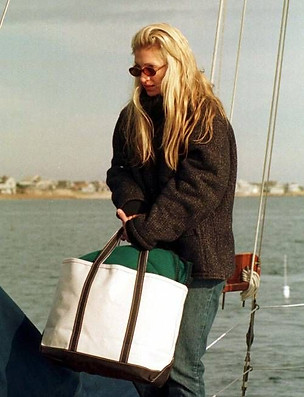
Carolyn Bessette - Kennedy in 1997 with her L.L.Bean boat and tote.
L.L.Bean introduced a simple canvas bag called the Ice Bag - designed to carry heavy blocks of ice, cut from frozen lakes in Maine, all the way to the kitchen. Its design was straightforward: a rectangular base, an open top, and two strong handles stitched to carry almost anything. Function shaped form -and form, as history shows, often seduces fashion. (Think of denim, once the uniform of miners and sailors, later adopted by models and designers alike.) By the 1960s, women in New York began carrying these bags to markets and beaches — not for elegance, but for practicality - and in doing so, turned simplicity into style. It wasn’t until the age of logos that the tote found its way into every wardrobe. Shops, galleries, and cultural institutions began printing their names across its cotton surface, transforming it from a mere carrier into a “quiet” declaration. Around the same time, the L.L.Bean Boat and Tote — with its boxy base, contrast trim, and indestructible canvas — became the definitive “boat bag,” bridging utility and identity.

To carry a tote bag was to say something — about yourself, where you come from, what you value, what you read, and where you’ve been. The tote became a language. By the late twentieth century, as minimalism and environmental awareness took the stage, the canvas bag made a graceful return- this time as a symbol of consciousness and restraint. It was no longer just fashion, but a statement of value. It whispered of reuse, resistance to plastic, and taste refined by simplicity. Designers like Phoebe Philo, the Olsen sisters for The Row, Saint Laurent, Polo, and others reimagined it in leather, linen, and heavy cotton- as if returning nobility to something that had never truly lost it.
And yet, at its core, the tote remains what it has always been: a generous, unpretentious vessel. Its beauty lies in its simplicity- no fast, no mass. More than the bag itself, it’s the story that makes it so effortlessly cool — the way it bridges practicality and style, past and present. Once you know its story, carrying it becomes something even better: you carry knowledge too.
And that, truly, is the chicest thing of all.